
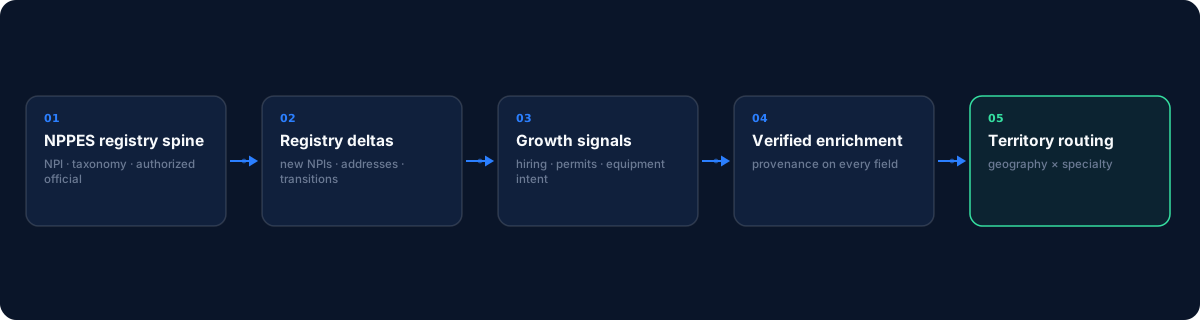
Why is NPPES the identity spine for provider data?
The National Plan and Provider Enumeration System is the closest thing US healthcare has to a ground-truth business registry: every provider and organization carries an NPI, a taxonomy (specialty), practice addresses and — critically for sales — an authorized official. Anchoring your account universe on NPI records eliminates the duplicate-and-orphan chaos that plagues healthcare CRMs built from list vendors.
Registry deltas are themselves signals: a new organizational NPI is a new practice forming (equipment, financing, software need); an authorized-official change often marks ownership transition; address additions mark expansion.
Practice-growth and financing signals
Beyond the registry: hiring postings for clinical and front-office roles (growth), equipment-financing search behavior (capex intent), lease and permit filings (new locations), and affiliation changes (system acquisition or independence events). Each maps to a distinct seller's motion — a practice adding its third location has different needs than one changing ownership.
For lenders, the same signal set drives practice-lending: new-practice formations need build-out capital; expansions need equipment financing; transitions need acquisition loans. Product-level tagging applies to healthcare exactly as it does to general commercial funding.
- New organizational NPI registrations (practice formation)
- Authorized-official changes (ownership/leadership transition)
- Multi-location address additions (expansion)
- Clinical hiring surges (volume growth)
- Equipment and build-out financing intent
- Taxonomy changes (service-line expansion)
Compliance posture: provenance or nothing
Healthcare outreach lives under more scrutiny than any other vertical. The operating rules: source signals only from public records and first-party consented properties; keep a provenance trail on every data point; verify contacts through documented enrichment waterfalls; and log every export for audit. PHI never enters a go-to-market pipeline — the unit of analysis is the practice as a business, not patients.
Vendors unable to show where each field came from are a liability, not a shortcut.
Territory activation
Healthcare selling is territorial. Route practice-level signals by geography and specialty taxonomy, attach the verified authorized-official contact, and give reps the trigger context ('third location registered in Maricopa County last week') as the opener. Signal-led territory reviews replace quarterly list refreshes with a weekly who-moved report.
How often is NPPES updated, and how do you handle the lag?
CMS disseminates the full NPPES file monthly and incremental update files weekly, and providers are obligated to report changes within 30 days — which means the registry runs days to weeks behind reality. Treat it as the spine, not the clock. The operational pattern is delta processing: diff each weekly file against your resolved universe, and let the deltas (new NPIs, address additions, authorized-official changes) fire as events rather than re-importing the world.
The lag is also why registry data alone under-calls timing. A new organizational NPI often appears after the practice signed its lease and ordered equipment. Pairing registry deltas with faster trails — hiring posts, permits, web research — recovers the weeks the registry loses, while the NPI keeps every faster signal anchored to a verifiable identity.
What does a compliant outreach workflow look like end to end?
It starts with provenance and ends with an audit log. Each account carries its NPI and the source of every layered field; enrichment runs through a documented waterfall with verification timestamps; outreach lists record who exported what, when, and under which campaign. Business contacts only — the unit of analysis is the practice as a company, never patients or clinical data.
The practical test: if a compliance officer picks any contacted practice at random, the team should produce the full chain — registry record, growth signal with source, contact verification, export log — in under five minutes. Vendors and internal pipelines that can pass that test survive procurement review; the ones that cannot become the reason a program gets shut down.
Glossary
- NPI
- National Provider Identifier — the unique ID for providers and healthcare organizations in the CMS NPPES registry.
- Authorized official
- The person legally designated in NPPES to act for a healthcare organization — a natural entry point for B2B outreach.
Sources & further reading
- CMS — NPPES NPI data dissemination files ↗
The official monthly full files and weekly incremental updates the registry spine is built from.
- CMS — NPPES NPI Registry search ↗
Public lookup for any NPI, taxonomy and authorized official.
- HHS — HIPAA for professionals ↗
The regulatory boundary any healthcare go-to-market program must design around.